
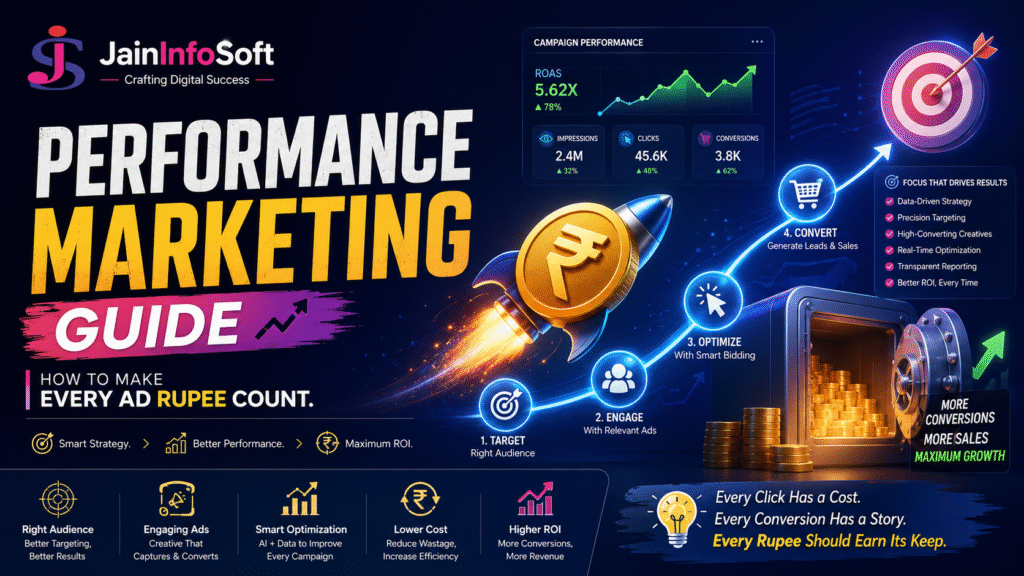
Most businesses don’t have an unlimited ad budget, so every rupee spent needs to justify itself. That’s the entire idea behind performance marketing — measuring results, not just running ads and hoping for the best.
This Performance Marketing Guide covers what performance marketing actually means, the channels it typically includes, how to track ROI properly, and the mistakes that quietly waste budget across almost every campaign.
By the end, you’ll have a clear framework for deciding where to spend, how to measure whether it’s working, and when to shift budget toward what’s actually delivering results.
What is Performance Marketing?
Performance marketing is a data-driven approach to advertising where campaigns are measured against specific, trackable outcomes — clicks, leads, sales, or app installs — rather than vague goals like “brand visibility.”
Unlike traditional advertising, where a business pays for exposure regardless of results, performance marketing ties spend directly to measurable action. This is why Paid Marketing Training today focuses so heavily on tracking and analytics, not just ad creation.
This shift matters because it changes how success gets defined. A traditional ad campaign might be considered successful simply because it reached a large audience, while a performance marketing campaign only counts as successful if it produces the specific action it was built to drive.
Main Channels Used in Performance Marketing
Performance marketing isn’t one platform — it’s a strategy applied across several channels at once.
- Google Ads — captures active search intent through Search and Shopping campaigns
- Meta Ads — reaches audiences on Facebook and Instagram through interest and behavior targeting
- Affiliate marketing — pays partners a commission for driving actual conversions
- Email marketing — nurtures leads with measurable open and click-through rates
- Influencer partnerships — increasingly tracked through unique discount codes or trackable links
Most businesses don’t rely on a single channel. Instead, they combine two or three, then shift budget toward whichever one delivers the strongest return.
How Performance Marketing Measures Success
Success in performance marketing comes down to a handful of key metrics, and knowing which one matters most depends on the campaign goal.
| Metric | What It Measures | When It Matters Most |
| CPC (Cost Per Click) | Cost of a single click | Traffic-focused campaigns |
| CPL (Cost Per Lead) | Cost of one qualified lead | Lead generation campaigns |
| CPA (Cost Per Acquisition) | Cost of one completed sale or sign-up | Conversion-focused campaigns |
| ROAS (Return on Ad Spend) | Revenue generated per rupee spent | E-commerce and sales-driven campaigns |
Tracking just one of these in isolation can be misleading. A low CPC means nothing if those clicks never convert into leads or sales.
Setting a Performance Marketing Budget That Works
Budget allocation is where many campaigns go wrong before they even launch. Spreading a small budget too thin across five channels usually performs worse than focusing on just one or two channels properly.
A practical approach looks like this:
- Start with one or two channels that match where your audience already spends time
- Set a modest test budget and run it long enough to collect real data
- Compare cost per result across channels before scaling any single one
- Reallocate budget toward the best-performing channel, rather than splitting evenly out of habit
Patience matters here too. Most channels need at least one to two weeks of consistent spend before the data becomes reliable enough to act on.
Reallocating budget too early is a common mistake. Judging a channel’s performance after just two or three days often means acting on incomplete data, which can lead to abandoning a channel that simply needed more time to find its audience.
Common Performance Marketing Mistakes
A few repeated mistakes quietly drain performance marketing budgets across almost every industry:
- Judging a campaign’s success by clicks alone, instead of actual conversions
- Running Google Ads and Meta Ads with no shared tracking or attribution
- Spreading budget too thin across too many channels at once
- Ignoring landing page quality, which affects conversion rates regardless of ad spend
- Failing to set up proper conversion tracking before the campaign even launches
Fixing the tracking setup alone often reveals which channels were actually working all along.
Real-Life Examples: Performance Marketing in Action
Seeing performance marketing applied to real scenarios makes the concept far more concrete.
Example 1: A Digital Marketing Institute
A digital marketing institute in Saharanpur runs Google Ads for high-intent keyword searches and a Meta Ads retargeting campaign for website visitors who didn’t enroll. By tracking cost per enrollment across both channels separately, the institute discovers that Meta Ads retargeting produces cheaper enrollments, and shifts more budget there while keeping Google Ads for capturing new, ready-to-enroll students.
Example 2: An E-Commerce Store
An online store selling furniture combines Google Shopping Ads with a Meta Ads catalog campaign. Google Shopping captures people already searching for specific products, while Meta Ads catalog campaigns show those same products to people who browsed but didn’t buy. Tracking ROAS across both channels shows which product categories perform best on each platform.
Example 3: A Local Service Business
A clinic uses a small performance marketing budget split between Google Search Ads for appointment-related keywords and a Meta Ads lead form campaign. After two weeks, cost-per-lead data shows the Meta lead form campaign converting more cheaply, so the clinic shifts most of its budget there while keeping a minimal Google Ads presence for high-intent searches.
Performance Marketing and AI: What’s Changed
AI has reshaped performance marketing significantly. Automated bidding on Google Ads and Advantage+ campaigns on Meta now handle much of the real-time optimization that used to require constant manual adjustment.
This doesn’t remove the need for strategy. Someone still has to set the right goals, choose the right channels, and write compelling ad copy. Tools like ChatGPT help draft ad variations quickly, giving these automated systems better creative to test against.
How Performance Marketing Connects to Other Channels
Performance marketing rarely works in isolation from other paid channels. It typically combines the fundamentals covered in a Google Ads Guide and a Meta Ads Guide into one coordinated strategy, rather than treating each platform as a separate project.
This is exactly why a complete Performance Marketing Course covers both platforms together, alongside tracking, analytics, and budget allocation as one connected skill set.
How to Learn Performance Marketing Properly
Performance marketing has a real learning curve, since it depends on data literacy as much as creative skill. A structured path looks like this:
- Learn the fundamentals of both Google Ads and Meta Ads individually
- Set up proper conversion tracking before running any real campaign
- Practice comparing cost per result across multiple channels
- Learn to shift budget confidently based on real performance data
This exact approach is built into Jain Infosoft’s Performance Marketing Course, which combines Google Ads, Meta Ads, and analytics training into one practical program.
For a broader skill set, this fits naturally into a complete AI Digital Marketing Course Saharanpur, where performance marketing sits alongside SEO, content, and AI tools training.
Frequently Asked Questions
Performance Marketing Basics
What is the difference between performance marketing and traditional advertising? Performance marketing ties ad spend directly to measurable outcomes like clicks, leads, or sales, while traditional advertising typically pays for exposure regardless of results.
Which metric matters most in performance marketing? It depends on the campaign goal — CPL matters most for lead generation, while ROAS matters most for e-commerce and sales-driven campaigns.
Can a small business really do performance marketing? Yes. Performance marketing scales to any budget, since success is measured by return on spend rather than by the total size of the budget itself.
Managing and Learning Performance Marketing
Should I use Google Ads or Meta Ads for performance marketing? Most successful performance marketing strategies use both together, since Google Ads captures active search intent while Meta Ads builds awareness and retargets warm audiences.
How long before performance marketing campaigns show real results? Most campaigns need one to two weeks of consistent spend before the data becomes reliable enough to guide budget decisions confidently.
Where can I learn performance marketing in Saharanpur? Jain Infosoft offers a dedicated Performance Marketing Course covering Google Ads, Meta Ads, and analytics through hands-on, campaign-based training.
Performance marketing rewards clear tracking and patience over guesswork. Businesses that measure the right metrics, test channels properly, and shift budget based on real data consistently get more out of every rupee spent than those relying on instinct alone — and that discipline compounds over time as tracking data builds into a genuine competitive advantage.
Want hands-on training in performance marketing across Google Ads and Meta Ads? Explore the Performance Marketing Course at Jain Infosoft or get in touch to book a free demo class.