
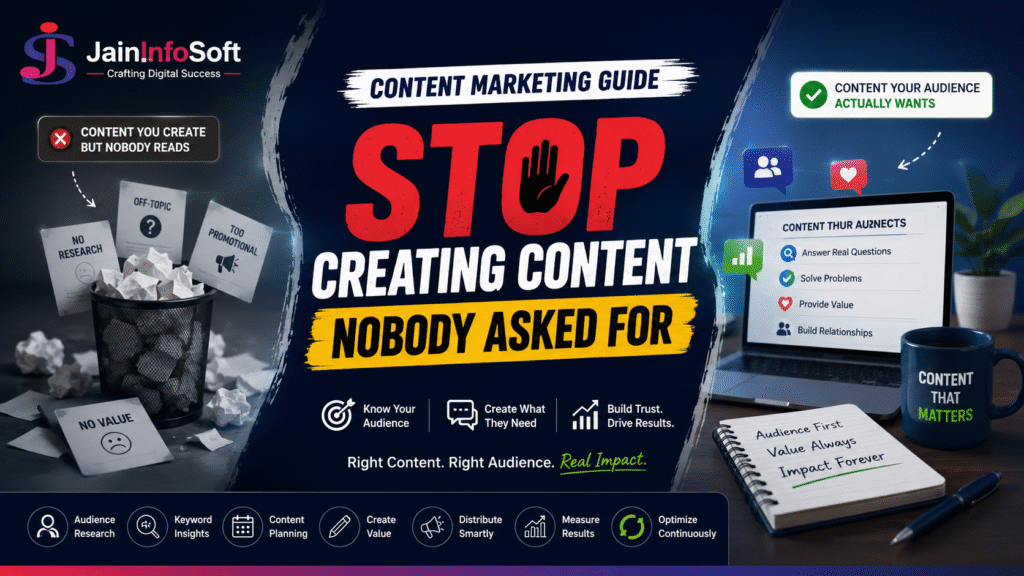
Most businesses publish content regularly and still see little return from it. The problem usually isn’t effort — it’s a missing strategy behind what gets published and why.
This Content Marketing Guide breaks down what actually makes content work, the formats worth prioritizing, how distribution matters as much as creation, and where a structured Content Marketing Course Saharanpur fits into building this skill properly.
By the end, you’ll have a clear framework for deciding what to create, where to share it, and how to measure whether it’s actually working.
What is Content Marketing, Really?
Content marketing means creating and sharing valuable content to attract and retain a clearly defined audience, with the ultimate goal of driving profitable customer action. It’s different from advertising, since the value comes first, and the sales pitch comes later, if at all.
This distinction matters because content that only promotes a product rarely earns attention. Content that genuinely helps, educates, or entertains earns trust first, then converts that trust into business results over time.
Think of it as the difference between a salesperson who talks only about their product and one who first takes the time to understand a customer’s actual problem. The second approach builds a relationship that eventually leads to a sale, often without ever feeling like a sales pitch at all.
Why Most Content Marketing Fails
Before covering what works, it’s worth understanding why so much content marketing quietly underperforms.
- Publishing without a clear target audience or specific goal in mind
- Creating content around what a business wants to say, not what the audience wants to know
- Ignoring distribution, and assuming good content will get discovered on its own
- Measuring success by publishing frequency instead of actual engagement or conversions
- Copying competitor content instead of building a distinct angle or voice
Fixing even the first two issues on this list usually improves results more than publishing more frequently ever would. A smaller amount of genuinely targeted content almost always outperforms a larger volume of unfocused posts, since the targeted content actually reaches people who care about the topic.
Core Content Formats Worth Prioritizing
Not every format deserves equal investment. Here’s how the most common content types compare for a typical small or mid-sized business.
| Format | Best For | Typical Effort |
| Blog posts | SEO visibility, answering specific questions | Medium |
| Short-form video | Social reach, brand personality | Medium to high |
| Email newsletters | Nurturing existing leads and customers | Low to medium |
| Case studies | Building trust with high-intent buyers | High |
| Infographics | Simplifying complex information, shareability | Medium |
Most businesses get the best return by focusing deeply on two or three formats, rather than spreading thin attention across all of them at once.
Building a Simple Content Strategy
A content strategy doesn’t need to be complicated to work. A practical structure looks like this:
- Define a specific audience and the problem your content solves for them
- Choose two or three core formats that match where that audience spends time
- Build a simple content calendar with realistic, sustainable publishing frequency
- Track engagement and conversions, not just views or publishing volume
- Refine the strategy every few months based on what’s actually working
Consistency matters more than volume here. A steady publishing rhythm of genuinely useful content usually outperforms a burst of content that fades out after a few weeks. Momentum in content marketing builds slowly, and abandoning a strategy too early, before search engines and audiences have had time to notice it, is one of the most common reasons businesses conclude content marketing “doesn’t work” for them.
Content Marketing and SEO: How They Connect
Content marketing and SEO work closely together, though they aren’t identical. SEO focuses on structure and visibility, while content marketing focuses on value and audience connection. The strongest content does both at once.
Our SEO Checklist covers the technical and on-page steps that make sure well-written content actually gets found, while a solid content strategy makes sure that content is worth finding in the first place.
Real-Life Examples: Content Marketing in Action
Seeing content marketing applied to real situations makes the strategy far easier to picture.
Example 1: A Digital Marketing Institute
A Saharanpur institute shifts from occasional promotional posts to a structured blog covering real student questions — course fees, placement details, and career comparisons. Within a few months, these posts start ranking on Google for specific searches, bringing in inquiries from students who never saw a paid ad at all.
Example 2: A Local E-Commerce Store
A furniture brand starts publishing short buying guides, like “How to Choose a Sofa for a Small Living Room,” instead of only posting product photos. These guides answer real questions shoppers search for, and several start ranking well enough to drive consistent traffic without any additional ad spend.
Example 3: A Service-Based Business
A clinic begins publishing simple, clear articles answering common patient questions. Instead of promotional language, the content focuses purely on being genuinely helpful. Over time, patients mention finding the clinic through these articles specifically, well before ever needing to book an appointment.
Using AI for Content Marketing
AI tools have changed how quickly content marketing teams can produce quality work. AI Content Writing tools help draft outlines, first versions of articles, and even social captions in a fraction of the time manual writing takes.
Tools like ChatGPT work well for this, especially when paired with a clear content strategy. However, AI-generated drafts still need human editing for accuracy, tone, and genuine originality — content that reads as generic AI output tends to underperform with both readers and AI search engines looking for authentic, well-verified information.
The most effective approach treats AI as a speed multiplier, not a replacement for strategy. A clear content plan tells you what to write and why, while AI simply helps you produce the first draft faster, leaving more time for the editing and refinement that actually makes content stand out.
How Content Marketing Supports AI Search Visibility
Content built around real audience questions naturally supports Answer Engine Optimization and Generative Engine Optimization too. Clear structure, direct answers, and genuinely original insights are exactly what both Google and AI assistants like ChatGPT and Gemini look for when deciding what to reference. For a deeper look at how these strategies fit together, see our guide to SEO vs GEO vs AEO.
How to Learn Content Marketing Properly
Content marketing rewards strategic thinking as much as writing skill. A structured learning path looks like this:
- Learn how to define an audience and their specific content needs
- Practice writing across multiple formats — blogs, social captions, email
- Learn distribution basics, including SEO and social sharing
- Study how to measure content performance beyond just views
This exact approach is built into Jain Infosoft’s Content Marketing Course, combining strategy, writing practice, and AI tool training into one program.
For a broader skill set, this fits naturally into a complete AI Digital Marketing Course Saharanpur, where content marketing sits alongside SEO, social media, and paid advertising.
Frequently Asked Questions
Content Marketing Basics
What is the difference between content marketing and advertising? Content marketing provides genuine value first and earns attention through helpfulness, while advertising directly promotes a product or service to drive immediate action.
How often should a business publish content? Consistency matters more than frequency — a sustainable schedule of genuinely useful content, even weekly or biweekly, usually outperforms a burst of content that isn’t maintained.
What content format works best for beginners? Blog posts are usually the easiest starting point, since they support SEO directly and don’t require video production skills or equipment.
Applying Content Marketing Strategy
Can AI tools replace a content marketing team? No. AI tools like ChatGPT speed up drafting and ideation, but strategy, editing, and genuine originality still require human judgment and audience understanding.
How does content marketing connect to SEO and AI search? Well-structured, genuinely helpful content supports both traditional SEO rankings and AI-driven answer engines, since both prioritize clear, original, trustworthy information.
Where can I learn content marketing in Saharanpur? Jain Infosoft offers a dedicated Content Marketing Course covering strategy, writing, and AI tools through hands-on, practical training.
Content marketing works when it prioritizes genuine value over promotional noise. Businesses that understand their audience, choose the right formats, and stay consistent will always outperform those simply publishing for the sake of staying active — and that gap tends to widen the longer both approaches continue.
Want hands-on training in content marketing and copywriting? Explore the Content Marketing Course at Jain Infosoft or get in touch to book a free demo class.