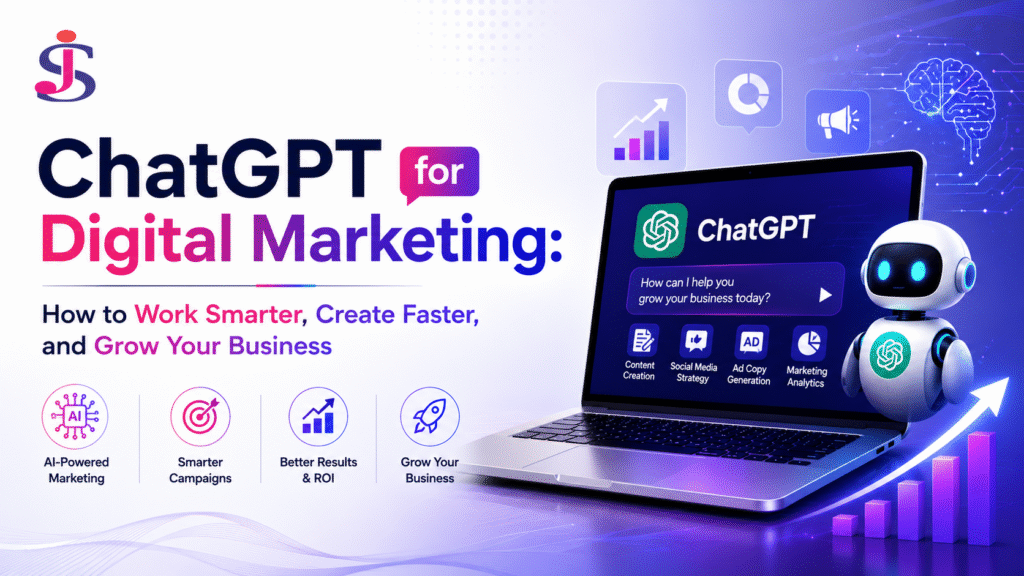
Most marketers already use ChatGPT for something. Fewer use it well. There’s a real gap between typing a quick question into ChatGPT and actually building it into a repeatable marketing workflow.
This guide covers ChatGPT for digital marketing in practical terms — where it genuinely helps, where it falls short, and how to learn it properly through structured AI Prompt Engineering rather than trial and error.
By the end, you’ll have a clear picture of where ChatGPT fits into a real marketing workflow, and where it still needs a human hand guiding the process.
Why Marketers Use ChatGPT
ChatGPT saves time on tasks that used to eat up a marketer’s day. It drafts content quickly, suggests ideas on demand, and handles repetitive writing work that once required a full content team.
Common uses include:
- Drafting blog outlines and first-draft articles
- Writing ad copy variations for testing
- Creating email sequences and subject lines
- Brainstorming social media captions and content calendars
- Summarizing research or competitor content quickly
None of these replace a marketer’s judgment. They simply remove the blank-page problem, so a marketer starts editing instead of starting from zero. That shift alone can turn a task that used to take an entire afternoon into something finished before lunch.
How ChatGPT Fits Into a Content Marketing Workflow
Content creation is where ChatGPT delivers the most obvious value. A marketer can generate five headline options in seconds, pick the strongest one, and move straight into writing — instead of staring at a blank document.
This works well for blogs, social posts, and email campaigns. However, quality still depends on the input. Vague prompts produce generic output. Specific prompts, with context, tone, and audience clearly defined, produce content that actually sounds like a real brand.
A useful habit is treating ChatGPT like a junior writer, not an autopilot. Give it the same brief you’d give a new team member — audience, goal, tone, and length — and the output improves dramatically compared to a one-line request.
Using ChatGPT for SEO and AI Search Visibility
ChatGPT also supports SEO work directly, especially around structure. Marketers use it to draft FAQ sections, brainstorm long-tail keyword variations, and rewrite dense paragraphs into clearer, more scannable content.
This matters beyond traditional Google rankings too. Content structured clearly — direct answers, organized headings, well-formed FAQs — is exactly what AI search engines like Gemini and Perplexity look for when deciding what to cite. So, using ChatGPT to tighten structure supports both SEO and GEO (Generative Engine Optimization) at once.
For marketers who want a deeper look at how these strategies connect, this ties directly into the broader idea of writing for both search engines and AI answer engines at the same time, rather than treating them as separate content projects.
ChatGPT vs Other AI Tools: Where It Fits
ChatGPT isn’t the only AI tool marketers use, and it isn’t meant to do everything. Here’s how it compares to other common tools in a typical workflow:
| Tool | Best For | Limitation |
| ChatGPT | Writing, ideation, research summaries | No built-in design or ad automation |
| Canva AI | Visual design and creative assets | Not built for long-form writing |
| Google Ads Smart Bidding | Automated ad budget optimization | Doesn’t help with content creation |
| GA4 (AI-enhanced) | Performance insights and forecasting | Doesn’t generate content or creatives |
Understanding this table matters. Marketers who rely on ChatGPT alone often hit a ceiling, since it handles writing and thinking, not design or automated ad delivery. The strongest results usually come from combining ChatGPT with one or two complementary tools inside the same campaign, rather than expecting one tool to cover every stage of the work.
Practical ChatGPT Use Cases for Marketers
Here’s a simple, practical sequence for using ChatGPT inside a real campaign:
- Use ChatGPT to brainstorm five content angles for a campaign topic
- Draft a first version of the content, then edit it for tone and accuracy
- Ask ChatGPT to summarize the content into short social captions
- Request FAQ-style answers for the same topic, formatted for AEO and GEO
- Review everything for factual accuracy before publishing
Skipping the review step is the most common mistake marketers make. ChatGPT can produce confident-sounding answers that are still factually wrong, so a final human check isn’t optional.
This five-step sequence works because it treats ChatGPT as one stage in a larger process, not the entire process itself. Each step still needs a marketer’s judgment — choosing the strongest angle, verifying claims, and making sure the final content actually matches the brand’s voice.
Common Mistakes Marketers Make with ChatGPT
A few repeated mistakes limit how useful ChatGPT actually becomes:
- Publishing AI output without editing or fact-checking
- Using vague prompts and expecting specific, on-brand results
- Treating every ChatGPT output as a final draft instead of a starting point
- Ignoring tone and brand voice, which makes content sound generic
- Not verifying statistics or claims ChatGPT generates on its own
Avoiding these mistakes is really the difference between using ChatGPT casually and using it as a genuine part of a marketing workflow. Marketers who treat it as a first-draft tool, not a finished product, consistently get better, more trustworthy results.
Why This Matters for Marketing Careers in Saharanpur
Employers increasingly expect marketers to already know how to use ChatGPT effectively, not learn it after being hired. For students building a career through an AI Digital Marketing Course Saharanpur, strong ChatGPT skills have become a genuine baseline requirement, not an optional extra.
This also matters for local businesses. A single marketer who knows how to use ChatGPT well can now produce the content output that once required a small team, making AI skills a real competitive advantage for smaller Saharanpur businesses. Owners who understand this shift are increasingly prioritizing candidates who already show comfort with AI tools during hiring.
How to Learn ChatGPT for Digital Marketing Properly
Learning ChatGPT well takes more than watching a few videos. A structured approach looks like this:
- Learn prompt structure first — context, tone, audience, and format all shape the output
- Practice inside real campaign scenarios, not isolated exercises
- Learn how to combine ChatGPT with other tools like Canva AI and SEO platforms
- Build a habit of reviewing and editing every output before it goes live
This structured path is exactly what Jain Infosoft’s ChatGPT Course is built around — covering prompt engineering, content workflows, and practical, campaign-based ChatGPT use rather than surface-level tips.
Rather than a single class on “how to use ChatGPT,” this kind of course works best when it’s built into a broader curriculum — one where students immediately apply what they learn to real campaign work, not isolated homework assignments that never connect back to an actual marketing goal.
If you’re comparing training options first, our guide to the Best Digital Marketing Institute in Saharanpur breaks down what a well-rounded, AI-ready curriculum should include.
Frequently Asked Questions
Getting Started with ChatGPT for Marketing
Can ChatGPT replace a content writer? No. ChatGPT speeds up drafting and ideation, but it still needs a human to edit for accuracy, tone, and brand voice before anything gets published.
What is prompt engineering, and why does it matter? Prompt engineering means structuring a request with clear context, tone, and format so ChatGPT produces more accurate and usable output, instead of generic or vague responses.
Is ChatGPT good enough for SEO content on its own? ChatGPT helps draft SEO-friendly structure, like FAQs and headings, but it still needs human review for accuracy, keyword strategy, and brand alignment before publishing.
Training and Career Questions
Where can I learn to use ChatGPT for digital marketing in Saharanpur? Jain Infosoft offers a dedicated ChatGPT Course covering prompt engineering, content workflows, and practical marketing use cases through hands-on, campaign-based training.
Do I need technical skills to learn ChatGPT for marketing? No. ChatGPT is built for non-technical users, and most marketing use cases only require clear communication and structured prompts, not coding knowledge.
How does ChatGPT support GEO and AI search visibility? ChatGPT helps structure content into clear, direct answers and FAQs, which is exactly the format AI search engines like Gemini and Perplexity favor when choosing what to cite.
ChatGPT isn’t a replacement for marketing skill — it’s a tool that rewards marketers who already know how to think strategically. Learning to use it well, through structured practice rather than guesswork, is quickly becoming a core digital marketing skill rather than a nice-to-have, much like SEO or social media management became standard skills a decade ago.
Want hands-on training in ChatGPT and AI prompt engineering for marketing? Explore the ChatGPT Course at Jain Infosoft or get in touch to book a free demo class.