
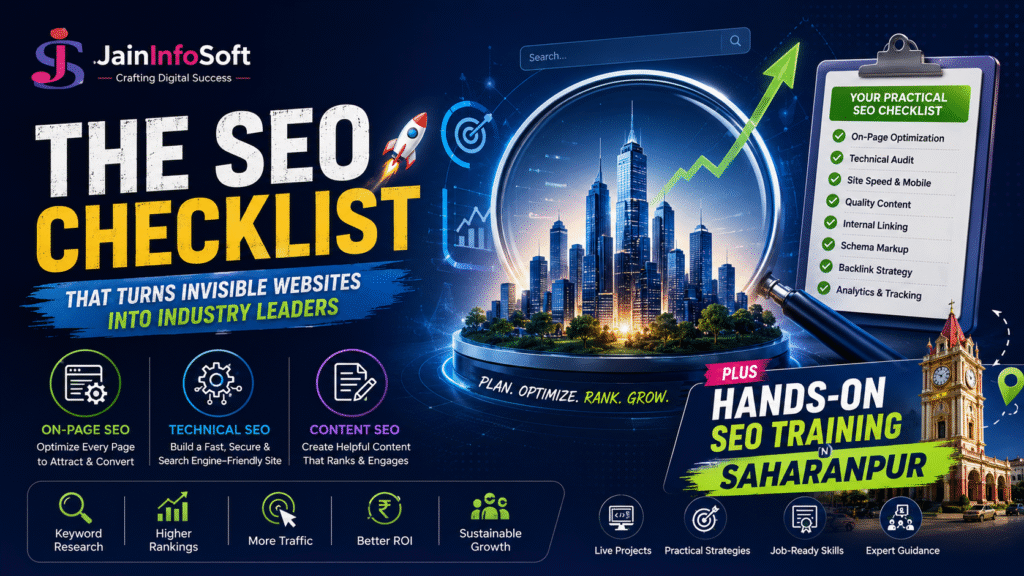
Writing a great blog post is only half the job. Without the right SEO steps, even genuinely useful content can sit unread on page five of Google. A clear process prevents that.
This SEO Checklist walks through the on-page, technical, and content steps worth checking before publishing anything — the same process taught in a structured SEO Training Saharanpur program, broken down into a practical, repeatable list.
By the end, you’ll have a clear reference you can run through before hitting publish on any page, rather than relying on memory and hoping nothing important got missed.
Why a Checklist Matters More Than a Memory
SEO involves dozens of small details, and it’s easy to skip one when working from memory alone. A written checklist removes that risk, especially when multiple people on a team are publishing content.
This matters even more now that content needs to work for both traditional Google rankings and AI-driven search. A missed step that seems minor — like a missing meta description or an unstructured heading — can quietly cost visibility in both places at once.
Think of a checklist the same way a pilot uses a pre-flight checklist. Most items are routine and rarely cause a problem on their own, but skipping the same one repeatedly, across dozens of pages, adds up to a real, measurable loss in visibility over time.
On-Page SEO Checklist
On-page SEO covers everything you control directly within the content itself.
- Include the primary keyword in the title, URL, and first 100 words
- Write a unique meta title under 60 characters
- Write a meta description under 155 characters that includes the primary keyword
- Use one clear H1, followed by a logical H2 and H3 structure
- Add descriptive alt text to every image
- Include internal links to relevant pages, using descriptive anchor text
- Keep paragraphs short and scannable, ideally two to four sentences
Skipping even two or three of these consistently weakens a page’s ranking potential, regardless of how strong the actual content is. Most of these steps take only a few minutes each, which makes them easy to overlook precisely because they feel too small to matter individually.
Technical SEO Checklist
Technical SEO covers the parts of a website that affect how search engines crawl and index it.
- Confirm the page loads quickly on both mobile and desktop
- Check that the page is mobile-friendly and passes Core Web Vitals
- Make sure the URL is clean, short, and keyword-relevant
- Verify the page has a valid canonical tag, avoiding duplicate content issues
- Check that the sitemap includes the new page
- Confirm there are no broken links or redirect chains
Most technical issues go unnoticed until they start affecting rankings, which is why a proactive check before publishing saves problems later.
Technical SEO problems are also the hardest to spot just by reading a page, since everything can look fine on the surface while search engines struggle to crawl or index it properly in the background. This is exactly why a checklist, rather than a quick visual glance, catches issues that would otherwise go unnoticed for months.
Content Quality Checklist
Good technical SEO can’t save weak content, and increasingly, AI search engines are just as strict about content quality as Google is.
| Check | Why It Matters |
| Answers the search intent directly | Improves both ranking and AI citation potential |
| Includes a clear FAQ section | Supports Answer Engine Optimization (AEO) |
| Uses original insights, not recycled information | Builds trust for Generative Engine Optimization (GEO) |
| Avoids thin or duplicate content | Prevents ranking penalties |
| Includes at least one table or list | Improves readability and AI extraction |
Content that checks all five of these boxes tends to perform well across Google, Bing, and AI-powered search experiences at once. In practice, this table works well as a final review step, right before a page goes live, since it forces a quick gut check on whether the content is genuinely useful or just technically correct.
Real-Life Examples: SEO Checklist in Action
Seeing this checklist applied to real scenarios makes it easier to spot what’s often missed.
Example 1: A Digital Marketing Institute
A Saharanpur institute publishes a blog about course fees but forgets to add an FAQ section. After adding five common questions students actually ask, along with clear answers, the page starts appearing in Google’s “People Also Ask” results within a few weeks — traffic it wasn’t getting before.
Example 2: A Local E-Commerce Store
A furniture store publishes several product pages with the same generic product description copied across similar items. After rewriting each page with unique details and a dedicated FAQ, Google stops treating the pages as duplicate content, and individual product pages begin ranking separately.
Example 3: A Service-Based Business
A clinic’s website loads slowly on mobile devices, quietly hurting its rankings despite genuinely strong content. After compressing images and fixing a few technical issues flagged by Core Web Vitals, mobile rankings improve within a month, without changing a single word of the actual content.
How This Checklist Supports AI Search Visibility
Every item on this checklist does double duty. A clear FAQ section supports Answer Engine Optimization. Clean headings and structured content support Generative Engine Optimization (GEO), since AI systems favor content they can extract and quote confidently. If you want a deeper look at how these strategies connect, our guide to SEO vs GEO vs AEO breaks down exactly how they work together.
This also connects directly to AI SEO vs Traditional SEO, since a strong technical and on-page foundation is what makes AI-focused optimization possible in the first place. Skipping the basics and jumping straight to AI-specific tactics rarely works, since AI search engines still rely heavily on the same signals traditional SEO has always valued.
Using AI Tools to Speed Up This Checklist
Going through this checklist manually for every page takes time, and AI tools can genuinely help. Tools like ChatGPT can draft FAQ sections, suggest meta descriptions within character limits, and flag missing structure — though every suggestion still needs a human review before publishing. Treat AI output here the same way you would a first draft from a junior team member: useful, but not the final word.
How to Learn SEO Properly
Following a checklist helps, but understanding why each step matters makes the process far more effective long term. A structured learning path looks like this:
- Learn on-page fundamentals first — titles, headings, and keyword placement
- Study technical SEO basics, including site speed and mobile usability
- Practice writing content that satisfies both search intent and AEO/GEO structure
- Review real pages regularly against a checklist like this one
This exact progression is built into Jain Infosoft’s SEO Training program, combining on-page, technical, and content strategy into one practical course.
For a broader skill set, this fits naturally into a complete AI Digital Marketing Course Saharanpur, where SEO sits alongside Google Ads, Meta Ads, and AI tools training.
Frequently Asked Questions
SEO Checklist Basics
What is the most important item on an SEO checklist? Matching the content to real search intent matters most, since even perfect technical SEO can’t save a page that doesn’t actually answer what the reader is searching for.
Do I need to follow every item on this checklist for every page? Most items apply to nearly every page, though some, like sitemap updates, only need occasional checking rather than a fresh review each time.
How often should I re-check published pages against an SEO checklist? Reviewing older, high-traffic pages every few months helps catch outdated information and technical issues that can develop over time.
Applying the SEO Checklist
Can AI tools help complete an SEO checklist faster? Yes. Tools like ChatGPT can draft FAQ sections and suggest meta descriptions quickly, though a human should still review everything for accuracy before publishing.
How does this checklist help with AI search visibility, not just Google? Clear structure, FAQ sections, and original content all support both traditional SEO and AI-driven visibility, since AI search engines favor the same clarity that helps Google understand a page.
Where can I learn SEO properly in Saharanpur? Jain Infosoft offers a dedicated SEO Training program covering on-page, technical, and content SEO through hands-on, practical training.
An SEO checklist isn’t about perfection on the first try — it’s about catching the small details that quietly cost visibility before they ever become a problem. Running through a clear list before every publish is one of the simplest habits that consistently pays off, and it gets faster every time you repeat it.
Want hands-on training in SEO fundamentals and AI-driven search? Explore SEO Training at Jain Infosoft or get in touch to book a free demo class.