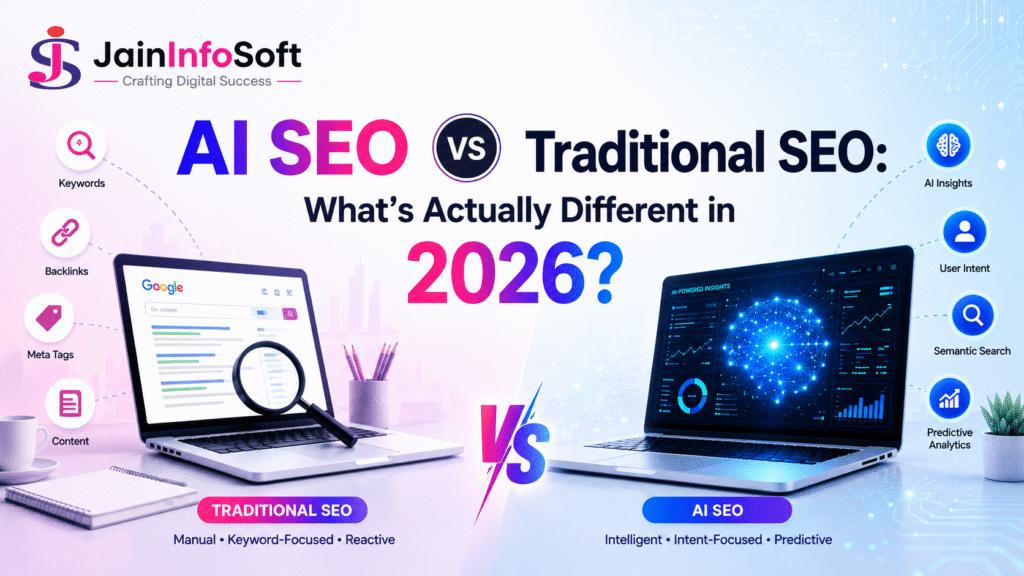
Every SEO conversation these days eventually turns into a debate: is traditional SEO still enough, or does everyone now need to learn AI SEO instead? The honest answer is more nuanced than either side usually admits.
This guide breaks down AI SEO vs Traditional SEO clearly — what each one actually involves, where they overlap, where they genuinely differ, and which skills are worth prioritizing if you’re building a career in AI Digital Marketing right now.
What is Traditional SEO?
Traditional SEO is the practice of optimizing a website so it ranks higher in Google’s search results. It relies on keyword research, on-page optimization, backlinks, technical fixes, and content that matches search intent. It’s been the foundation of digital marketing for over two decades, and it still works.
However, traditional SEO rests on one core assumption: users type a query into Google and click through a list of ten blue links. That assumption no longer tells the whole story.
This doesn’t mean traditional SEO has stopped working — far from it. Most websites, including AI-search-optimized ones, still need strong technical SEO, well-researched keywords, and quality backlinks to build authority. What’s changed is simple: ranking on Google is no longer the only destination worth optimizing for.
What is AI SEO?
AI SEO means optimizing content so it performs well in an AI-influenced search environment. This covers Google’s AI Overviews and, increasingly, direct citations inside tools like ChatGPT, Gemini, and Perplexity. AI SEO borrows heavily from traditional SEO fundamentals, but it adds a new layer: structure and clarity that AI models need in order to extract and quote content confidently.
This is where Generative Engine Optimization (GEO) comes in. Marketers use this term specifically for optimizing content so AI systems choose to reference it when they generate answers.
AI SEO vs Traditional SEO: Side-by-Side Comparison
Here’s how the two approaches compare across the factors that matter most:
| Factor | Traditional SEO | AI SEO / GEO |
| Primary Goal | Rank in Google’s search results | Get cited inside AI-generated answers |
| Content Structure | Keyword-optimized paragraphs | Clear, self-contained, question-answer format |
| Success Metric | Ranking position, click-through rate | Citation frequency, AI answer visibility |
| Backlinks | Central ranking factor | Still relevant, but trust and clarity matter more |
| Content Format | Long-form articles, blog posts | Structured FAQs, tables, direct answers |
| Update Frequency | Periodic content refreshes | Continuous accuracy checks, since AI models retrain often |
Importantly, this table shows a difference in emphasis, not a replacement. Traditional SEO doesn’t disappear — it becomes the base layer that AI SEO builds on top of.
GEO vs SEO: Are They Actually Different Disciplines?
Not entirely. Think of GEO as a specialized extension of SEO, not a separate field. Both still depend on relevant keywords, trustworthy content, and a well-structured website. The difference lies in the destination. SEO aims to rank your page. GEO aims to get an AI system to reuse your page’s information inside its own generated answer.
So, in practice, a well-optimized page today needs to work toward both outcomes at once. That means:
- Structuring content with clear headings and direct answers, not buried explanations
- Including FAQ sections with self-contained answers AI systems can lift and quote
- Using tables and lists, since AI systems extract structured data more reliably than dense paragraphs
- Maintaining factual accuracy, since AI models trust and repeat consistent, verifiable information more readily
Consider a simple example. A traditional SEO article might explain the difference between two marketing terms across several paragraphs, building slowly toward a conclusion near the end. An AI-optimized version states the direct answer in the first sentence or two, then uses the rest of the paragraph to add context. Both versions can rank well on Google. Only the second version, though, is easy for an AI model to lift and quote accurately.
Why This Shift Matters for Marketers and Businesses
Search behavior has genuinely changed. A growing share of questions people used to type into Google now go straight into AI assistants instead. A marketer who only understands traditional SEO is optimizing for half the search landscape. A marketer trained in both SEO and AI Search Optimization, on the other hand, can capture visibility in both places.
This shift also affects hiring. Businesses — including those looking for a Best Digital Marketing Institute in Saharanpur — increasingly want marketers who understand AI-driven search alongside traditional ranking factors, not just one or the other.
For small and local businesses specifically, this shift can level the playing field. A business that shows up clearly and accurately in an AI-generated answer can gain visibility that would otherwise take years of traditional link-building on Google alone. This makes AI SEO a genuinely practical skill for marketers who work with smaller, local clients — not just large brands with big content budgets.
Do You Need to Choose Between AI SEO and Traditional SEO?
No — and trying to choose one over the other would be a mistake. Traditional SEO fundamentals like keyword research, site structure, and technical health remain necessary. AI SEO simply adds a new layer on top, focused on structure and clarity for AI extraction.
In fact, most SEO professionals working today are simply extending their existing skill set rather than starting over. If you already understand traditional SEO, learning AI SEO is a natural next step, not a completely new discipline. The underlying research and content-quality principles carry over directly.
How to Start Learning AI SEO
If you’re serious about building AI SEO skills alongside traditional SEO, a structured path beats picking up random tips online. A practical sequence looks like this:
- Build strong fundamentals first through dedicated SEO Training
- Learn how AI search engines retrieve and cite content differently from traditional Google rankings
- Practice restructuring existing content into AI-friendly formats — tables, FAQs, direct answers
- Track performance across both traditional rankings and AI citation visibility
Jain Infosoft’s AI SEO Course follows this exact progression. It combines traditional SEO training with hands-on GEO practice, so students learn both sides of modern search rather than only one.
Where AI SEO Fits Into a Broader Digital Marketing Career
AI SEO doesn’t exist in isolation. It connects directly to the tools and skills taught in a complete AI Digital Marketing Course Saharanpur — including AI content creation, ChatGPT for content and research, and broader AI marketing tools that support SEO work.
Understanding both traditional SEO and AI SEO also opens up stronger long-term career opportunities in digital marketing. Businesses are actively looking for marketers who can handle both sides of modern search, not just one.
If you’re comparing institutes before enrolling anywhere, check our guide on choosing the Best Digital Marketing Institute to see what a well-rounded, AI-integrated curriculum should include.
Frequently Asked Questions
SEO vs AI SEO Basics
What is the main difference between AI SEO and traditional SEO? Traditional SEO focuses on ranking a website in Google’s search results. AI SEO focuses on getting content cited or referenced inside AI-generated answers from tools like ChatGPT, Gemini, and Google AI Overviews.
Is GEO the same as AI SEO? GEO, or Generative Engine Optimization, is essentially the practical technique behind AI SEO. Both terms describe optimizing content so AI systems choose to reference it when generating answers.
Should I learn traditional SEO or AI SEO first? Learn traditional SEO fundamentals first. AI SEO builds directly on core skills like keyword research, content structure, and technical website health.
AI SEO Careers and Training
Is traditional SEO becoming obsolete because of AI search? No. Traditional SEO remains the foundation for website visibility. AI SEO adds an extra layer focused on AI answer engines — the two work together, not as replacements for each other.
What skills does an AI SEO course usually cover? A strong AI SEO course typically covers traditional SEO fundamentals, content structuring for AI extraction, FAQ and schema optimization, and tracking visibility across both Google rankings and AI-generated answers.
Why is AI SEO training important for a digital marketing career? Businesses increasingly look for marketers who understand both traditional ranking factors and AI-driven search visibility. This makes AI SEO a valuable, increasingly expected skill for long-term career growth.
AI SEO and traditional SEO aren’t competing philosophies — they’re two halves of how content gets discovered today, whether by a person typing into Google or an AI assistant answering a question directly. Marketers who understand both are simply better equipped for where search is heading, regardless of which platform their audience happens to use. Ignoring either half means leaving visibility, and potential clients, on the table.
Want to learn both traditional SEO and AI SEO under one structured program? Explore the AI SEO Course at Jain Infosoft or get in touch to book a free demo class and see the full curriculum.