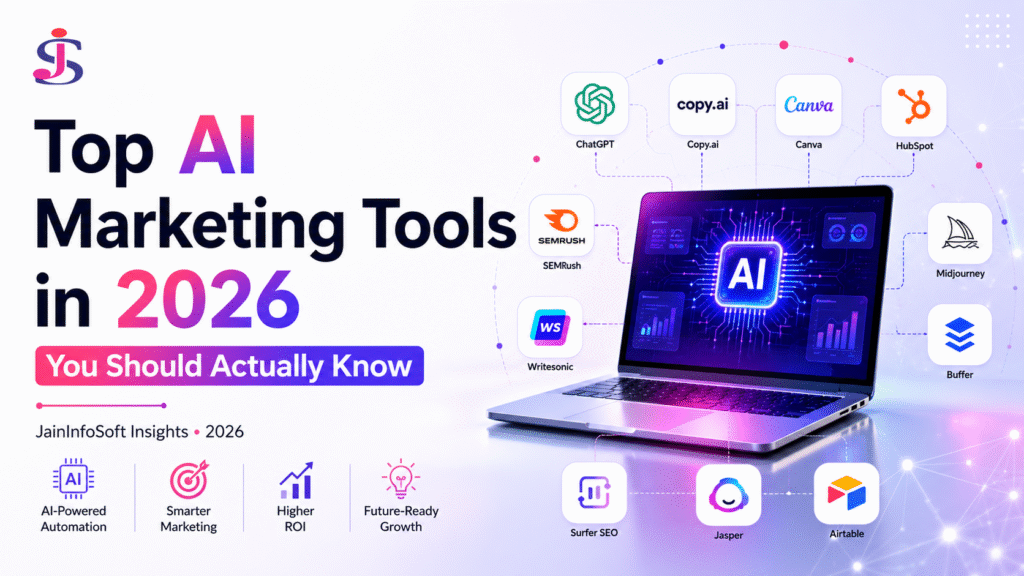
New AI tools launch almost every month, and it’s easy to feel like you’re always one step behind. The good news: you don’t need to learn fifty tools. A small, focused set of AI marketing tools covers almost everything a marketer needs in 2026.
This guide breaks down the top AI marketing tools in 2026, organized by what they actually help you do — content, design, SEO, ads, and analytics — so you know exactly where to start and why each one matters.
Why AI Marketing Tools Matter More Than Ever
Marketing teams today move faster, publish more content, and run more campaigns than ever before. AI tools make that pace possible. They handle repetitive tasks, generate first drafts in seconds, and surface insights that would otherwise take hours to find manually.
More importantly, AI tools have become genuinely accessible. You don’t need a technical background or a large budget to use them. This is exactly why more institutes now build AI Marketing Tools Training directly into their core digital marketing curriculum, rather than treating it as an optional add-on.
The real skill in 2026 isn’t knowing that these tools exist — most marketers already know the names. The actual advantage comes from knowing which tool fits which task, and how to combine two or three of them inside a single campaign without wasting time switching back and forth.
Top AI Content Creation Tools
Content still drives most marketing campaigns, and AI has changed how fast that content comes together.
- ChatGPT — drafts blog outlines, ad copy, email sequences, and social captions in seconds
- Gemini — strong for research-heavy content and summarizing large amounts of information quickly
- Claude — useful for long-form writing, detailed strategy documents, and nuanced content review
These tools work best as a starting point, not a final draft. Marketers still need to edit, fact-check, and add brand voice before publishing anything AI generates.
That last step matters more than most people realize. Content that reads as generic AI output tends to perform worse, both with readers and with AI search engines that increasingly favor original, well-verified information over recycled phrasing. Treat these tools as fast first-draft generators, and keep the final polish as a human step.
Top AI Design Tools
Visual content used to require dedicated designers or hours of manual work. AI has shortened that timeline significantly.
- Canva AI — generates social media creatives, presentation slides, and ad visuals in minutes
- Midjourney — creates highly detailed AI-generated imagery for campaigns that need a distinct visual style
- AI-powered video editors — trim, caption, and repurpose long videos into short clips automatically
For most small businesses and marketing teams, Canva AI alone covers the majority of day-to-day design needs.
Top AI SEO and GEO Tools
SEO tools have evolved well beyond keyword trackers. Today’s AI SEO tools help structure content specifically for how both Google and AI answer engines process it.
| Tool Type | What It Does | Why It Matters in 2026 |
| AI keyword research tools | Identify search intent, not just search volume | Improves content relevance |
| AI content structuring tools | Suggest headings, FAQs, and formatting | Improves visibility in AI Overviews |
| AI SEO auditors | Flag technical and structural SEO issues | Keeps sites competitive on Google |
| GEO tracking tools | Monitor if content gets cited by AI assistants | Measures visibility beyond Google rankings |
If you want a deeper breakdown of how these tools fit into the bigger picture, our guide on AI SEO vs Traditional SEO covers exactly where AI-driven SEO tools fit into a modern strategy.
Top AI Ads and Automation Tools
Paid advertising has moved further into automation than almost any other marketing area.
- Google Ads Smart Bidding — automatically adjusts bids in real time to hit campaign goals
- Meta Advantage+ — uses AI to find and target the right audience without manual segmentation
- AI chatbots — handle customer queries instantly, freeing up teams for higher-value work
- AI automation platforms — connect tools together so leads move through a funnel without manual follow-up
These tools reduce daily manual work significantly. However, they still need a human setting clear goals, budgets, and guardrails. An AI system can optimize toward whatever target you give it, but it can’t decide what that target should be, or catch when a campaign is technically “working” while missing the actual business goal.
Top AI Analytics and Insight Tools
Data used to sit in dashboards, waiting for someone to interpret it. AI has changed that too.
GA4’s AI-enhanced reporting now predicts trends instead of only showing historical numbers. It flags anomalies automatically and suggests likely causes, so marketers spend less time digging through raw data and more time acting on it.
This shift matters because faster insight leads to faster decisions — and in competitive markets, speed often determines who captures an opportunity first. A marketer who spots a dip in campaign performance within hours, instead of at the end of the month, has far more room to fix it before real budget gets wasted.
How to Learn These Tools the Right Way
Reading about AI marketing tools and actually using them inside a real campaign are two very different experiences. Getting genuinely comfortable with these tools takes structured, hands-on practice, not scattered YouTube tutorials.
A practical learning path looks like this:
- Start with the tools most relevant to your role — content, design, ads, or analytics
- Practice each tool inside a real or simulated campaign, not in isolation
- Learn how these tools work together, since most real campaigns combine several at once
- Track results, since knowing a tool exists isn’t the same as knowing when to use it
This structured approach is exactly what Jain Infosoft’s AI Tools Training is built around — covering ChatGPT, Gemini, Canva AI, and other core AI marketing tools through hands-on, campaign-based practice.
Many self-taught learners skip straight to step three — trying to combine tools — before they’ve built confidence with any single tool on its own. That approach usually creates more confusion than progress. A structured course sequences this properly, building tool-by-tool confidence first, then showing how those tools fit together inside a real campaign workflow.
Why This Matters for Careers and Businesses in Saharanpur
Employers increasingly expect marketers to already know how to use AI tools, not learn them on the job. For students and professionals building a career through an AI Digital Marketing Course Saharanpur, strong AI tool skills are quickly becoming a baseline requirement rather than a bonus.
For local business owners, these tools also matter directly. AI-powered marketing lets a small team compete with much larger competitors, without needing a large in-house marketing department. A single well-trained marketer, equipped with the right AI tools, can now realistically handle work that used to require an entire small team.
Frequently Asked Questions
Getting Started with AI Marketing Tools
What are the most important AI marketing tools to learn in 2026? ChatGPT and Gemini for content, Canva AI for design, AI SEO tools for search visibility, and Google Ads or Meta Advantage+ for automated ad optimization cover most of what a marketer needs.
Do I need technical skills to use AI marketing tools? No. Most AI marketing tools, including ChatGPT, Canva AI, and Meta’s ad automation features, are built for non-technical users and require no coding knowledge.
How many AI tools should a beginner learn first? Start with two or three tools relevant to your role, such as ChatGPT for content and Canva AI for design, before expanding into SEO or ad automation tools.
Training and Career Questions
Where can I get hands-on AI marketing tools training in Saharanpur? Jain Infosoft offers dedicated AI Tools Training covering ChatGPT, Gemini, Canva AI, and other core marketing tools through live, campaign-based practice.
Will AI marketing tools replace marketing jobs? No. AI tools handle repetitive tasks, but they still need a marketer to guide strategy, review output, and make final decisions, which keeps skilled marketers in demand.
How is AI SEO different from other AI marketing tools? AI SEO tools focus specifically on structuring content so it ranks on Google and gets cited by AI search engines, while other AI marketing tools focus on content creation, design, or ad automation.
AI marketing tools aren’t optional extras anymore — they’re quickly becoming the standard toolkit every marketer is expected to know. Starting with a focused set of tools, and learning them through real campaigns rather than theory, is the fastest way to stay ahead in a field that keeps moving.
Want hands-on training with ChatGPT, Gemini, Canva AI, and more? Explore AI Tools Training at Jain Infosoft or get in touch to book a free demo class.