If you’ve searched for “digital marketing course” recently, you’ve probably noticed almost every institute now adds “AI” in front of it. It’s not just a trend word. AI Digital Marketing marks a genuine shift in how brands plan, create, and run campaigns — and it’s changing what employers expect marketers to know.
So, this guide breaks down what AI digital marketing actually means, how it differs from the marketing you already know, which tools power it, and how you can start learning it — even if you’ve never touched AI before.
What Does AI Digital Marketing Mean?
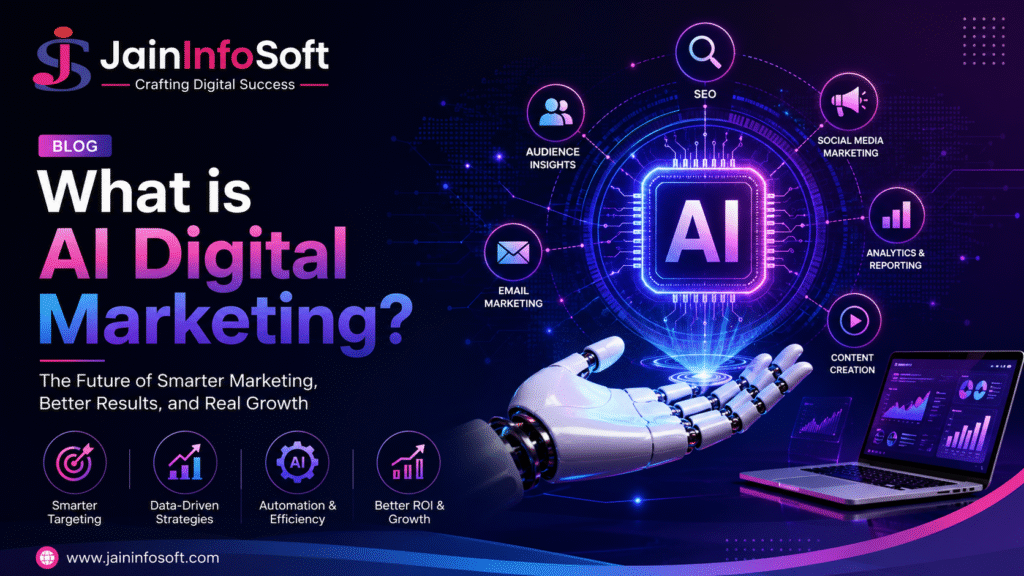
AI Digital Marketing means using artificial intelligence — tools like ChatGPT, Gemini, and AI-powered ad platforms — to plan, create, automate, and optimize marketing activities that marketers previously handled manually.
For example, instead of a marketer spending hours writing ad copy, researching keywords one by one, or manually adjusting ad budgets, AI tools now handle much of this groundwork. As a result, the marketer’s job shifts from doing everything by hand to guiding, checking, and improving what the AI produces.
In practice, AI in digital marketing typically shows up in places like:
- Writing first drafts of blogs, ads, and social captions
- Suggesting keywords based on real search intent, not just search volume
- Automatically adjusting ad bids and audiences in real time
- Personalizing website content based on visitor behavior
- Powering chatbots that handle customer questions instantly
- Predicting which campaigns are likely to perform before they launch
How is AI Digital Marketing Different from Traditional Digital Marketing?
Traditional digital marketing already used tools — Google Analytics, keyword planners, scheduling apps. However, what’s different with AI digital marketing is that the tools now make decisions, not just show data.
| Task | Traditional Approach | AI-Powered Approach |
|---|---|---|
| Keyword Research | Manual search + spreadsheet sorting | AI identifies intent-based keyword clusters |
| Ad Copywriting | Written entirely by hand | AI drafts multiple variations in seconds |
| Audience Targeting | Broad demographic guesses | AI targets based on real behavior patterns |
| Budget Optimization | Manual bid adjustments | AI auto-adjusts bids in real time |
| Content Personalization | Same content for all visitors | Dynamic content based on user activity |
| Reporting | Manual report building | AI-generated insights and forecasts |
The core idea: AI doesn’t remove the marketer from the process. It removes the repetitive, low-value parts of the job so the marketer can focus on strategy and creative decisions.
What Are the Most Common AI Marketing Tools?
A small number of AI marketing tools now cover most of what a beginner needs to learn. Here’s a practical breakdown:
- ChatGPT / Gemini — used for content ideas, ad copy drafts, email sequences, and research
- Canva AI — quick design generation for social posts and creatives
- AI SEO tools — help structure content so it ranks well on Google and gets picked up by AI search tools
- GA4 (AI-enhanced Google Analytics) — predicts trends instead of just reporting past data
- Google Ads Smart Bidding & Meta Advantage+ — automatically optimize ad delivery and spend
None of these tools require a technical or coding background. In fact, most digital marketing training today, including hands-on AI Digital Marketing Training, focuses on teaching people how to use these tools practically inside real campaigns — not how to build AI models from scratch.
Using Multiple AI Tools Together
What matters more than knowing the names of these tools is knowing when to use which one, and how to combine them inside a single campaign. For instance, a marketer might use ChatGPT to draft five ad headline variations, then use Canva AI to generate matching creatives in minutes, and finally let an automated bidding system decide which combination performs best with real audiences. This kind of layered workflow — tool plus tool plus platform automation — is ultimately what separates someone who has “used ChatGPT once” from someone who can run an AI-assisted campaign from start to finish.
Why Has AI Digital Marketing Become So Important Right Now?
The biggest reason is that how people search has changed. A large share of questions that used to go into Google now go straight into ChatGPT, Gemini, or Perplexity instead. So, instead of getting ten blue links, people get one direct answer.
Consequently, this shift has created two parallel goals for marketers:
- SEO — ranking well on Google’s traditional search results
- GEO (Generative Engine Optimization) — getting your content cited or recommended when someone asks an AI assistant a question
Therefore, a business that only optimizes for Google search is now missing half the picture. Brands and marketers who understand both, however, put themselves in a position to get discovered in more places, with less competition than the crowded Google-only landscape.
Think of it this way: if someone asks Google “best digital marketing institute in Saharanpur,” ranking well means your website shows up in the results list. But if that same person asks ChatGPT or Gemini the identical question, there’s no list of ten links — instead, the AI model builds one answer from whichever sources it trusts most. To earn a mention inside that single answer, your content needs clear structure, real information, and language an AI system can extract and quote confidently. That’s essentially the practical difference between traditional SEO and GEO, and why more institutes and agencies now write content with both in mind from the outset.
Who Actually Needs to Learn AI Digital Marketing?
You don’t need to be a “tech person” to use AI in marketing. In fact, four kinds of people benefit the most:
- Students choosing a career path with strong long-term demand
- Business owners who want better marketing results without hiring a large team
- Freelancers who want to offer AI-powered services at a premium
- Working marketers who want to stay relevant as hiring expectations shift
If you fall into any of these groups, the skill gap isn’t technical — it’s practical exposure. Reading about AI tools and actually using them inside a real campaign are very different experiences.
Why This Matters for Businesses in Saharanpur and Smaller Cities
AI tools have quietly closed a big gap between big-city marketing budgets and small-town business marketing. For instance, a local shop or service business in Saharanpur, Muzaffarnagar, or similar cities can now run AI-assisted ad campaigns, generate content faster, and compete for attention online without needing a large in-house marketing team.
This shift is also why local hiring for AI-skilled marketers is picking up — businesses increasingly want people who can run lean, AI-supported marketing rather than large traditional teams.
How to Start Learning AI Digital Marketing
Getting started doesn’t require a complicated path. Instead, a practical sequence looks like this:
- Build a solid base in core digital marketing — SEO, social media, and ads fundamentals
- Get comfortable using AI tools like ChatGPT, Gemini, and Canva AI for real tasks
- Practice on live campaigns, not just theory or mock projects
- Learn from mentors who are actively running AI-powered campaigns, not just teaching from slides
This is the exact structure behind Jain Infosoft’s AI Digital Marketing Course Saharanpur — combining core marketing fundamentals with hands-on AI tool training, live client-style projects, and placement support once the course is complete.
Frequently Asked Questions
What is AI digital marketing in simple words? AI digital marketing is the use of AI tools like ChatGPT, Gemini, and smart ad platforms to plan, create, and optimize marketing campaigns faster and more accurately than fully manual methods.
Is AI going to replace digital marketers? No. AI replaces repetitive manual tasks, not strategic thinking or decision-making. Marketers who know how to use AI tools effectively are more in demand, not less.
Do I need coding skills to learn AI digital marketing? No. Tools like ChatGPT, Gemini, Canva AI, and AI-powered ad platforms are built for non-technical users and require no coding knowledge.
What is the difference between SEO and GEO in AI digital marketing? SEO focuses on ranking a website in Google’s search results, while GEO (Generative Engine Optimization) focuses on getting content cited or recommended by AI systems like ChatGPT and Gemini when users ask questions directly.
How long does it take to learn AI digital marketing? With consistent, hands-on training, most learners can reach practical working proficiency within two to three months, depending on how deep the course goes into live projects.
Is there demand for AI digital marketing skills in smaller cities like Saharanpur? Yes. As AI tools make quality marketing more affordable, local businesses in tier-2 and tier-3 cities are increasingly looking to hire marketers who can run effective, AI-assisted campaigns on a limited budget.
AI digital marketing isn’t a passing trend — it’s fast becoming the standard way teams plan and execute marketing. So, the sooner you build hands-on comfort with these tools, the bigger the head start you get, whether you’re building a career or growing a business.
Ready to learn AI digital marketing with real tools and real campaigns? Explore the AI Digital Marketing Course at Jain Infosoft and see the full curriculum, duration, and placement details.