
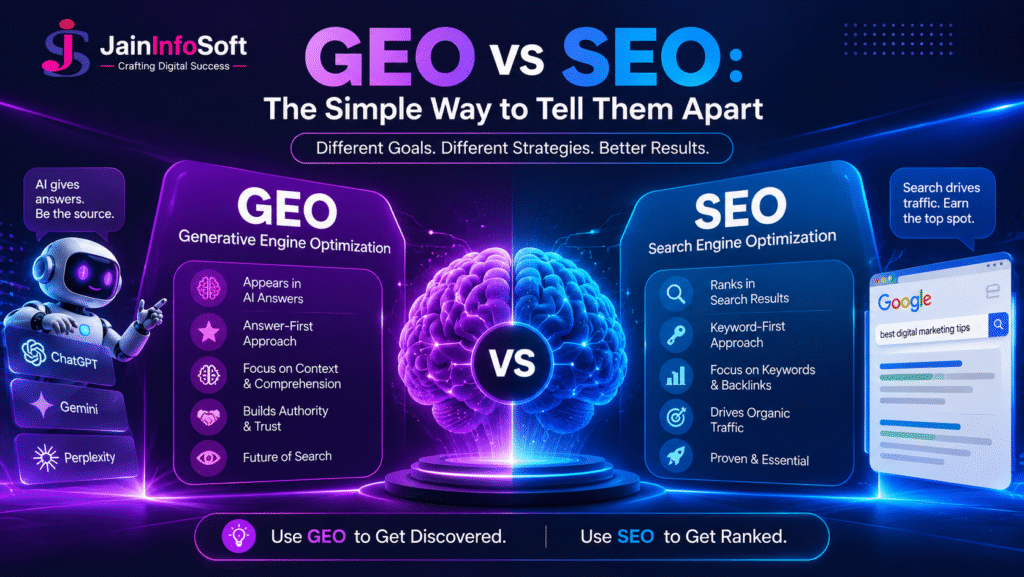
Students in our classes ask this almost every week: is GEO just a new name for SEO, or something genuinely different? The honest answer is that they overlap heavily, but they optimize for two different destinations.
This guide keeps things practical — a direct GEO vs SEO comparison, real tactics for each, and where structured GEO Training fits if you want to build both skills properly. For a broader look at how AEO fits into this picture too, see our detailed guide on SEO vs GEO vs AEO.
By the end, you’ll have a clear, quick-reference answer for this question the next time someone asks you the same thing.
The One-Line Difference
SEO gets your website ranked on Google. GEO gets your content referenced inside an AI-generated answer from tools like ChatGPT, Gemini, or Perplexity. Both depend on quality content and real authority, but they’re built for different moments in a person’s search journey.
Think of SEO as winning a spot on a shelf full of options, where the shopper still has to pick one. GEO is closer to being the answer a knowledgeable friend gives directly, skipping the shelf entirely.
Neither one is inherently better. They simply serve different search behaviors, and most audiences use both throughout a single day without even noticing the switch between them.
GEO vs SEO: Quick Comparison
Here’s a side-by-side breakdown worth bookmarking, since this is the exact comparison most people are actually looking for when they search “GEO vs SEO.”
| Question | SEO | GEO |
| Where does it show up? | Google’s search results page | Inside an AI chatbot’s generated answer |
| What earns visibility? | Backlinks, keywords, technical health | Clarity, accuracy, and trusted structure |
| How is success measured? | Ranking position, organic clicks | Citation frequency inside AI answers |
| Does the user visit your site? | Usually, yes | Not always — the answer may fully satisfy them |
| How often does content need updating? | Periodic refreshes | More frequent, since AI models retrain often |
This table is worth revisiting any time you’re deciding where to put your next hour of content work.
Tactics That Work for SEO
Traditional SEO tactics remain effective and still form the foundation everything else builds on.
- Target specific, well-researched keywords with clear search intent
- Build backlinks from relevant, trustworthy websites
- Fix technical issues — site speed, mobile usability, broken links
- Structure content with clear headings that match how people actually search
None of these tactics are new, and that’s precisely the point. SEO fundamentals have stayed remarkably stable even as the search landscape around them has shifted dramatically, which is exactly why they’re still worth mastering before adding anything GEO-specific on top.
Tactics That Work for GEO
GEO tactics borrow from SEO but push further toward clarity an AI system can extract with confidence.
- Answer the core question directly within the first two or three sentences
- Use tables and lists, since AI systems extract structured data more reliably than dense prose
- Keep FAQ answers self-contained, so they make sense even pulled out of context
- Publish original data or insight, since AI models favor sources that add something new
- Keep information current, since outdated facts reduce the odds of being cited confidently
Notice that none of these tactics actively hurt SEO either. A more direct answer, cleaner structure, and self-contained FAQs all tend to help a page’s Google ranking too, which is exactly why GEO feels less like a competing discipline and more like a sharper version of good SEO habits.
Real-Life Examples: GEO vs SEO in Practice
Seeing this applied to different businesses makes the distinction far more concrete.
Example 1: A Bakery Comparing Two Searches
A local bakery ranks on Google for “birthday cake shop near me” through solid local SEO — Google Business Profile, reviews, and location keywords. Separately, someone asks ChatGPT “what should I look for in a good birthday cake bakery,” and ChatGPT references the bakery’s blog post on cake ingredients and freshness, because that post answers the question clearly and specifically. The bakery earns visibility from both channels, using two different strategies, without running a single additional ad.
Example 2: A Software Company Explaining a Feature
A software company writes a detailed comparison article and it ranks on Google for “project management tool comparison.” When someone instead asks an AI assistant “which project management tool is best for small teams,” the AI pulls specific, clearly structured points from that same article — but only because the article states clear conclusions rather than a vague, hedge-everything summary. A weaker version of the same article, full of qualifiers like “it depends” without ever committing to a recommendation, would likely rank fine on Google but rarely get quoted by an AI system looking for a confident, specific answer.
Example 3: A Digital Marketing Institute’s FAQ Page
An institute’s FAQ page ranks reasonably on Google for a handful of long-tail questions. Once the institute rewrites each answer to be fully self-contained — restating the question’s context within the answer itself — those same FAQs start appearing inside AI-generated responses to similar student questions, since the answers no longer depend on surrounding context to make sense. The Google ranking barely changes, but the AI citation rate improves noticeably within a few weeks.
Do You Need to Choose Between Them?
No. Every GEO tactic listed above still helps traditional SEO too — clear structure and direct answers improve both Google rankings and AI citation odds at the same time. The reverse isn’t quite as true, which is why GEO tends to feel like an additional layer on top of SEO, not a separate strategy running in parallel.
In practice, this means the smartest approach isn’t picking a side at all. It’s writing every piece of content with both destinations in mind from the start, rather than optimizing for Google first and treating AI visibility as an afterthought tacked on later.
Where to Learn Both Together
Rather than treating GEO as a separate course, the most practical approach folds it into a single, structured SEO program. Jain Infosoft’s AI SEO Course covers exactly this — traditional SEO fundamentals alongside dedicated GEO Training, so students learn to build content that works for both destinations from the start.
For a broader skill set, this fits naturally into a complete AI Digital Marketing Course Saharanpur, where SEO and GEO sit alongside content, ads, and AI tools training. Learning them together, rather than as separate certifications, mirrors how they actually get applied on a real client project.
Frequently Asked Questions
GEO vs SEO Basics
Is GEO replacing SEO? No. GEO builds on top of SEO rather than replacing it — strong technical SEO and content quality are still necessary before AI systems are likely to trust and cite a source.
What’s the fastest way to explain GEO to someone new to it? GEO is optimizing content so AI assistants like ChatGPT and Gemini choose to reference it in their answers, the same way SEO optimizes content so Google ranks it in search results.
Do I need separate content for SEO and GEO? No. Well-structured, clear, and accurate content tends to support both at once — GEO mainly asks you to be more direct and self-contained than typical SEO content requires.
Applying GEO and SEO Together
Which should a beginner learn first, SEO or GEO? Learn SEO fundamentals first, since GEO builds directly on core skills like keyword research, technical health, and content structure.
How can I tell if my content is getting cited by AI systems? Ask relevant questions directly to tools like ChatGPT or Gemini and see whether your brand or content gets referenced, since there isn’t yet a fully standardized tracking tool for this.
Where can I learn SEO and GEO together in Saharanpur? Jain Infosoft’s AI SEO Course covers both traditional SEO and GEO Training in one structured program, combining foundational skills with AI-search-specific tactics.
GEO and SEO aren’t rivals competing for the same budget — they’re two destinations worth optimizing for at once, using content that’s mostly the same either way. Get the fundamentals right, add clarity and structure on top, and both channels tend to improve together, often without any additional work beyond what good SEO already asks of you.
Want to learn SEO and GEO in one structured program? Explore the AI SEO Course at Jain Infosoft or get in touch to book a free demo class.